In response to Kentucky legislation regarding suicide prevention training and awareness for middle school and high school staff and students, the Department for Behavioral Health, has provided a Suicide Prevention Training Tool Kit.
2026-2027 Supporting Staff and Students: An Evidence-Based Approach to Suicide Prevention
Quick Guide: Suicide Prevention Best Practices
Suicide Prevention Education for Middle and High School Staff
KRS 156.095 was amended to require a four (4) year recurring professional development training schedule that includes all professional development for certified personnel. Within twelve (12) months of initial hire and at least once every four (4) years thereafter, all certified school district employees and public charter school employees must complete at least one (1) hour of high-quality, evidence-based suicide prevention training, including risk factors, warning signs, protective factors, response procedures, referral, postvention, and the recognition of signs and symptoms of possible mental illness. KDE partners with the Kentucky Department for Behavioral Health, Developmental and Intellectual Disabilities (DBHDID) to identify training options to help districts meet this requirement through the resources below.
Suicide Prevention Information for Middle and High School Students
KRS 158.039 – Every public school and public charter school shall provide two (2) high quality, evidence-based suicide prevention awareness lessons each school year, the first by September 15 and the second by January 15, either in person, by live streaming, or via a video recording to all students in grades six (6) through twelve (12). Every public school shall provide an opportunity for any student absent on the day the high quality, evidence-based suicide prevention awareness lesson was initially presented to receive the lesson at a later time. The information may be obtained from the Cabinet for Health and Family Services or from a commercially developed suicide prevention training program.
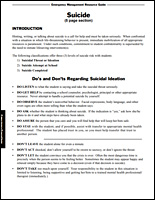
Kentucky Center for School Safety’s Emergency Management Resource Guide has a section on Suicide
Hinting, writing, or talking about suicide is a call for help and must be taken seriously. When confronted with a situation in which life-threatening behavior is present, immediate mobilization of all appropriate resources is paramount. Under such conditions, commitment to student confidentiality is superseded by the need to initiate life-saving interventions.
Download
Together, we can create awareness and give emotional support to those who may be contemplating suicide. If you or someone you know is in an emotional distress or suicidal crisis, please call the Lifeline at 1-800-273-TALK (8255).
Sources of Strength for Middle/High schools is a peer-led, evidence-based, mental health wellness program that utilizes the power of peer social networks to change unhealthy norms and cultures.
The elementary program utilizes a curriculum-based approach and keeps an upstream focus to increase health and wellness and decrease negative downstream outcomes by using active learning, talking circles, guided reflection and celebrating growth.
Learn moreEvery student deserves good mental health. Erika’s Lighthouse is a nonprofit on a mission to provide free mental health programs for any school, anywhere. Erika’s Lighthouse works upstream, putting easy-to-use school mental health programs in place to end the youth mental health crisis at the start.
Learn more
This page offers evidence-based recommendations for creating safe and effective messages to raise public awareness that suicide is a serious and preventable public health problem.
National Association of School Psychologists – The suicide of a student has a rippling effect in the school environment as well as in the greater community, as a single adolescent death by suicide increases the risk of additional suicides. The process by which a completed suicide (or at times, suicidal behavior) increases the suicidal behavior of others is called contagion.
The Public-Private Partnership Advancing the National Strategy for Suicide Prevention
The Center for Disease Control and Prevention hosted a webpage dedicated to suicide prevention, statistics, strategies and research. This site also includes podcasts on suicide prevention. (Department of Health and Human Resources)
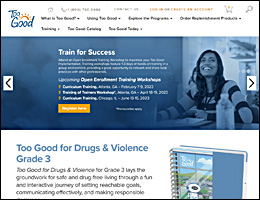
Too Good – Program Summary – Too Good is a comprehensive family of evidence-based substance use and violence prevention interventions designed to mitigate the risk factors linked to problem behaviors and build protection within the child to resist problem behaviors. Too Good develops and reinforces a comprehensive skills framework including setting reachable goals, making responsible decisions, identifying and managing emotions, and effective communication in addition to peer-pressure refusal, pro-social peer bonding, and peaceful conflict resolution skills. Too Good builds the basis for a safe, supportive, and respectful learning environment.
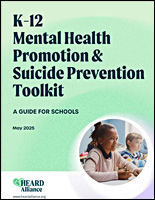
The K-12 Mental Health Promotion & Suicide Prevention Toolkit offers schools a structured approach to promoting wellbeing, responding effectively to crises, and supporting communities in the aftermath of loss. (Heard Alliance)
National Center for School Crisis and Bereavement (NCSCB) – Guidelines designed to respond to the needs of students and staff after a suicide has impacted the school environment.
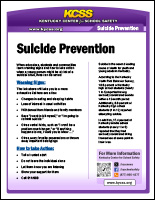
When educators, students and communities learn warning signs and how to take action when a young person might be at risk of a suicidal crisis, lives can be saved. (KCSS Handout)
Download
My Life is Worth Living™ is the first animated series that models the human connection shown to be protective against suicide. The series tells stories of characters who face some of the most difficult issues that young people deal with and shows their evolution in the key decision: that life is worth living.
Understanding and preventing suicide through research, education, and advocacy
Promoting a public health approach to suicide prevention
The goal of the American Association of Suicidology (AAS) is to understand and prevent suicide
Together, we can create awareness and give emotional support to those who may be contemplating suicide. If you or someone you know is in an emotional distress or suicidal crisis, please call the Lifeline at 1-800-273-TALK (8255)
Date Last Reviewed: May 2026